The Session Architecture Every Coach Should Steal
A 60-minute delivery hour: contract, data, insight, experiment, close. Minute marks and the three ways coaches blow it.


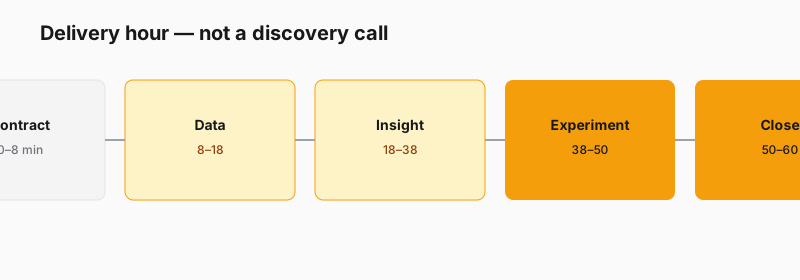
The discovery call is a sales hour: connect, diagnose, enroll. Steal that skeleton for selling. Do not run it again once they are paying you. A delivery hour has a different job — change something, then leave a contracted experiment.
Most coaches run a friendly conversation with a clock. The client leaves “feeling heard.” Nothing moves. Then you both stare at progress notes that say 5/10 for the fourth week.
Here is a 60-minute architecture you can steal tomorrow. Minute marks are the point. If you cannot point at the clock, you do not have a structure. You have a vibe.
| Beat | Minutes | Job | You talk |
|---|---|---|---|
| Contract | 0–8 | Name today’s outcome | 30% |
| Data | 8–18 | What they did since last time | 20% |
| Insight | 18–38 | One distinction, not a tour of their childhood | 30% |
| Experiment | 38–50 | One next action they can finish | 30% |
| Close | 50–60 | Recap, score, next date | 40% |
Those percentages are a ceiling, not a personality test. If you are over them, you are performing.
Why the Default Fails
The default session is: “How was your week?” then 40 minutes of story, then a scramble to “land something” at minute 55. Clients learn to bring weather. You learn to rescue. Everyone is tired. Nobody can say what changed.
The cost is not “a soft hour.” The cost is a practice that cannot show movement, so renewal becomes guilt and boundaries get treated as selfish.
The fix: contract the hour in public, then refuse to do work that isn’t on the contract.
Beat 1 — Contract (minutes 0–8)
Open like you mean it:
“If this hour works, what will be different when you leave? One sentence.”
Write the sentence where they can see it. That is the contract. Everything else is a distraction you can park.
If they give you three outcomes, make them pick one. Three outcomes is how you run over.
Do not recap last month. Do not share a resource “real quick.” The contract is the resource.
Beat 2 — Data (minutes 8–18)
Ask what they did, not how they felt about the idea of doing it.
“What did you actually try? What did you skip? What surprised you?”
This is the only place the last experiment lives. If they did nothing, that is data. Do not punish it. Do not pretend it was a full try. Name it and move.
If you already keep three-point notes, read the last insight out loud and ask: “Still true?” You are not rereading the novel of their life. You are checking a single line.
Beat 3 — Insight (minutes 18–38)
One distinction. Not five. The test: can they repeat it back in a sentence you did not feed them?
Your job is to listen for the sentence they keep circling and make it visible. Clean language helps: their words, not your metaphor collection.
When you feel the itch to teach, you are probably about to dump advice. Dumping advice is a failure mode, not a style.
If the insight needs 30 minutes of history to “set context,” you are on a history tour. History tours feel deep. They are how you miss the experiment.
Beat 4 — Experiment (minutes 38–50)
One action. Finishable. Dated.
“What’s the smallest version of this you will actually do before we meet? When, and how will I know?”
Not a homework packet. Not a reading list. One experiment. If they cannot picture Tuesday, it is not an experiment. It is a wish.
Write it in the same place you write the contract. If it isn’t written, it will dissolve in the parking lot.
Beat 5 — Close (minutes 50–60)
Close is not “great work today.” Close is:
- Repeat the contract and whether you hit it.
- Repeat the experiment and the date.
- A 1–10 on the session goal, not their life.
- Next session on the calendar before they leave.
If you routinely blow 60, you do not have a time problem. You have a contract problem. The close got stolen by Beat 3.
The Three Failure Modes
Advice dump. You got excited. They nodded. Nothing is now theirs. If you hear yourself listing options, stop and ask: “Which one of those is yours?”
History tour. Minute 18 becomes minute 48 because the story was “important.” It was. It is also endless. Park it: “That’s a different hour. Today we contracted X.”
Running over. You are training them that your boundaries are decorative. End on time even if the insight is mid-sentence. “We’re at time. The experiment is Y. We pick this up [date].”
A Worked Hour
Client: “I keep almost sending the offer.” Last score: 5/10 on “offer is live.”
- Contract: “Leave with a send/don’t-send decision and a dated first send.”
- Data: They drafted. They did not send. They rewrote the headline four times.
- Insight: “Almost” is protecting them from a specific no, not from a bad offer.
- Experiment: Send the current draft to two real buyers by Thursday 4pm. No rewrite first.
- Close: Score 6 on “decision exists.” Next Tuesday booked. Recap in writing same day.
You did not fix the offer. You contracted a behavior. That is the hour.
If they arrive in crisis that is not coaching, you do not force this architecture. You pause and send them to licensed care. Architecture is for the delivery hour you agreed to run.
The Clock on the Table
Put a visible timer where both of you can see it. Announce beat changes out loud: “We’re moving to experiment.” Clients who hate the timer at first are usually the ones who later say the hour finally went somewhere.
If you work in 45s or 90s, keep the five beats and scale the middle. Do not add a sixth beat called “flex.” Flex is how Beat 3 eats the close.
A 30-Minute Version
Same five beats, half the air:
- Contract: 4
- Data: 5
- Insight: 10
- Experiment: 6
- Close: 5
Do not invent a sixth beat called “just one more thing.”
What Most Coaches Get Wrong
They treat structure as cold. Clients do not experience a contract as cold. They experience it as being taken seriously. The warm fuzzy hour is the one where they cannot remember what they paid for.
They also mix this architecture with the discovery skeleton. Discovery enrolls a stranger. This hour enrolls an experiment. If you “re-close” the package every week, you are anxious, not thorough.
Steal this and print it. Tape it where your camera can’t see it. After two weeks, you will stop looking at the tape and start hearing the beat changes in your body. That is the point of a stolen architecture: you stop inventing the hour every Tuesday.
Notes After the Hour
Same day, three lines: insight, experiment, score. That is the entire note. If you cannot write it in two minutes, the hour did not produce an artifact. Tomorrow’s 12-minute prep depends on those three lines existing.
Send the client the same three lines. Not a recap essay. The contract, the experiment, the score. They should be able to forward it to a spouse and have it make sense.
If you skip the written close “because you ran over,” you taught them the hour evaporates. Don’t.
Training Yourself Off Vibe
For two weeks, record the start time of each beat in the margin. You will hate this. You will also see that Beat 3 started at minute 11 and ended at minute 52. That is the whole diagnosis of a mushy practice.
Then stop recording times. Keep the bones.
You do not need a new certification for this. You need a clock and the willingness to disappoint a story that is not on the contract.
If you lead groups, the same five beats still apply: contract the call, get data from pairs, one insight for the room, one experiment each, close on time. Group tools picked a platform. Do not invent a different religion for cohorts.
The First Week You Steal This
Print the table. Use it for every paid hour this week, including the ones that feel “too relational for structure.” Relational is Beat 3. The clock still exists.
If a client balks at the timer, name the job: “I’m protecting the experiment. If we skip it, you paid for weather.” Most people relax when they hear the contract is for them, not for your productivity theater.
Do not announce a “new methodology.” Just run the beats. After four hours they will start arriving with a sentence. That sentence is the whole point of a stolen architecture.
When DIY Isn’t Enough
If your notes, reminders, and client-facing recap still live in five tabs, the architecture will rot. Launch, Grow, and Scale exist to make book / deliver / collect quiet enough that you can stay in Beat 3. The hour is the product. The stack is how you protect it.
Want a delivery hour that doesn’t depend on your memory? Let’s talk.