How to Hold a Room: Facilitation Skills Group Coaches Skip
Status, energy, conflict, time, belonging. The piece the tools post never wrote.


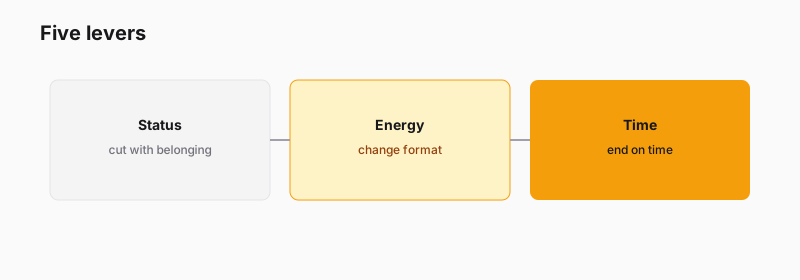
Group coaching tools picked a platform. 1:1 to group moved the offer. Group close ends the hour. This is the missing piece: how you hold status, energy, conflict, time, and belonging so peers do half the work. The sprint offer will fail if the room is a podcast with a mute button. Burnout in group looks like you talking for 40 minutes because silence scared you.
You are not the smartest person in the room. You are the clock, the interrupter, and the person who remembers the contract.
| Lever | You watch | You do |
|---|---|---|
| Status | Who takes air, who shrinks | Timed shares; interrupt with belonging |
| Energy | Flat, spiked, checked-out | Name it; change the format, not the sermon |
| Conflict | Side-eyes, pile-ons | Public repair or off-line; no taking sides |
| Time | Beat 3 eating the close | Announce the beat; end ugly and on time |
| Belonging | Who hasn’t spoken | A small named question, not a spotlight |
Why Tools Don’t Hold Rooms
A circle link is not a container. Containers have rules that get enforced when it’s awkward. If you only enforce when it’s easy, you don’t have rules.
The fix: five levers, said in week 0, practiced every call.
Status
Someone will take 40% of the air. Someone will take 2%. Your job is not to shame the first. It is to give the second a turn that ends, and to cut the first with belonging: “You’re in. Pause. Two other voices.”
If you wait for them to notice, they won’t. Status is a clock problem.
Energy
A flat room is usually an underspecified prompt or a lecture you didn’t admit to. Name it: “The energy dropped. We’re going to pairs for four minutes on [one question].” Do not add a pep talk. Pep talks are how you become the entertainment.
A spiked room (laughter, pile-on) still needs a contract. Fun is allowed. Fun that leaves no experiment is a party you sold as coaching.
Conflict
If the room saw it, repair in 60 seconds and return to the job. If it’s history or identity, off-line. Neutrality is not a personality. It is refusing to make one client your favorite in public.
You will want to process. Processing is how a 12-person call becomes couples therapy with an audience.
Time
Announce beat changes. “We’re in harvest. Two minutes.” End on time even if the insight is mid-sentence. Groups you run late train lateness. Groups you end train the close.
The last five minutes are commits, not “any last thoughts?”
Belonging
Belonging is not snacks and a Slack. It is: you will not be erased, you will not be humiliated, you will get a turn. The overtalker interrupt is a belonging move for the quiet ones. The cut at two minutes is a belonging move for everyone who came to work.
If someone disappears for two weeks, that’s a reach-out, not a public call-out.
A 75-Minute Shape
- 0–10: arrival, pairs, contract
- 10–40: one format (circle or two hot seats)
- 40–45: energy check — change format if dead
- 45–65: second format or deeper seat
- 65–75: spoken commits, stop
One live job per half. If you add a guest and a teaching and a hot seat, you held nothing.
What Most Coaches Get Wrong
They think holding the room means being warm. Warmth without a clock is a host. Hosts get thanked and not renewed.
They also copy classroom facilitation: raise hands, wait for volunteers. Coaching groups need named turns and cuts.
They take the conflict home and triangulate by DM. That’s how rooms rot.
Training Yourself
For four calls, tally talk-ratio (you vs them) and who spoke last. If you are over 30%, you performed. If the same two people close every call, you have a status leak.
Tape the five levers where the camera can’t see them. After two weeks you will hear the room shift before you look at the tape.
Week 0 Language
Send this before call 1:
“I will cut people at time. I will invite quiet voices by name. Conflict we all saw gets a 60-second repair. We end on commits, not last thoughts. If that sounds cold, this may not be your room.”
People who want a hangout will self-select out. Good.
A Repair You’ll Use
Two members talk over each other. You: “I heard two things. Both can wait one minute. Contract is X. We go there.” Then you go. If you process the fight, you taught the room that conflict is the product.
After the call, off-line only if identity or safety is in play. Not to soothe your favorite.
Practice cuts on a recording of yourself. You will hear the extra sentence you add after “pause.” That sentence is status leaking back to you. Delete it next time.
If the room is new, do timed shares in week 1 even if it feels stiff. Stiff is how belonging gets built. Loose week 1 is how week 4 is a podcast.
You will want a slide deck. Don’t. The contract in chat is enough. Slides make you a teacher. Teachers don’t cut.
The flagship is this: five levers, enforced when awkward. Everything else is decoration.
A Worked 75 Minutes
Twelve people. Contract on the wall: “Leave with one experiment you will do by Thursday.”
0–10. Pairs on “what did you actually try.” You do not take shares yet. Arrival is data, not a round of weather.
10–40. Two timed hot seats, eight minutes each, plus harvest. You cut the first speaker at time with belonging: “You’re in. Pause. Two other voices.” The room hears that cuts are the product.
40–45. Energy check. It’s flat. You do not sermon. “Pairs, four minutes, one question: what are you protecting by not starting?” Format change, not pep.
45–65. Circle, named turns, two minutes each. Quiet members get a small question, not a spotlight. Tonight you just make sure they speak once.
65–75. Spoken commits. You stop mid-sentence if you have to. The close is the last beat, not “any last thoughts?”
You talked under 30%. The room did the work. That is holding it.
Scripts for the Five Levers
Status. “You’ve had the floor. I want two voices who haven’t. [Name], ninety seconds on the same question.” Then you watch the clock, not their face.
Energy. “The room dropped. We’re changing the format, not the topic.” Then you change it. Naming without changing is a weather report.
Conflict. “I heard two things. Both can wait one minute. Contract is X. We go there.” If it is identity or safety, “I’m taking this off-line after. We are not processing it as the hour.” This is the 60-second room move.
Time. “We’re in harvest. Two minutes.” Then you harvest. Announce the beat or the beat does not exist.
Belonging. “You will get a turn. You will not be erased. You will not be the show.” Say it in week 0. Enforce it when the overtalker is your favorite. The overtalker is a sibling, not a different religion.
Hybrid, Late, Missing
Someone on speakerphone in a Tesco is not “in the room.” Hybrid attendance is a rule, not a vibe. Cameras on or they are async. You do not perform for a black tile.
Late by eight minutes: they join at the next beat, not mid-hot-seat. Missing two weeks: a reach-out, not a public roll call. Public roll call is humiliation dressed as accountability.
If half the room is traveling in December, shorten the call. Do not hold a thin room and pretend the levers still have a quorum.
After the Call
Same day, four lines in your notes: who took air, who vanished, one conflict, the commit list. That is the tape. Next week’s open uses it.
If you triangulate by DM — soothing the favorite, warning the quiet one about the loud one — you are building a court, not a room. Off-line is for identity, safety, or a missed commit. Not for your nerves.
For four calls, tally talk-ratio. If you are over 30%, you performed. Facilitation is the clock, the interrupt, and the contract. Charisma is optional. The interrupt is not.
When DIY Isn’t Enough
When attendance, async, and the working agreement live in three tools, you will spend the hour hunting links. A cohort rail can hold that. You still have to interrupt. We will not sell you charisma.
Want a group whose rails let you be the clock instead of the radio? Let’s talk.