Intake That Coaches, Not Just Collects
Question design and how session 1 uses the answers. Complements the onboarding pipeline.


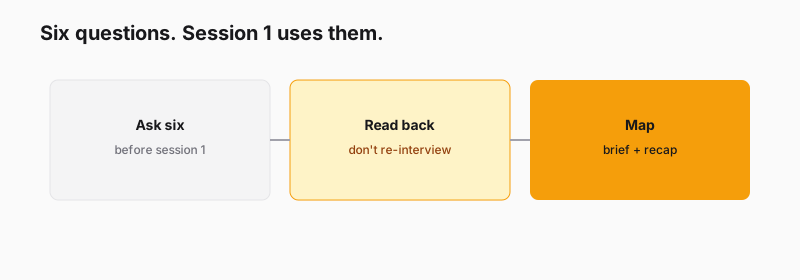
Automated onboarding owns the pipeline. The portal owns the tray. Progress owns the three points. This is question design — and how session 1 uses the answers instead of re-interviewing. Pair it with the one-page brief. Homework starts here if you ask for a current experiment, not a life story.
The Six Questions
- Outcome — “What will be true in 90 days that isn’t true now?”
- Score — “1–10 today on that.”
- Tried — “What have you already thrown at this?”
- Constraint — “What will get in the way on a normal Tuesday?”
- Done — “How will we both know this worked?”
- Landmine — “What should I not assume?”
That’s the form. Not a biography. Not a health history. If a question doesn’t change session 1, delete it.
How Session 1 Uses It
Do not re-ask what they wrote. Read it back.
“You scored this a 3. You already tried X. Tuesday constraint is Y. Today we turn that into a map, an agreement, and one experiment. What did I miss?”
Then build. If you re-interview, they learn the form was theater.
Put answers on the one-page brief the same day. Score goes into the first recap.
What You Do Not Ask
Anything that collects licensed-adjacent data “just in case.” Anything about children as if they were the client. Anything you will not read.
Long forms signal anxiety, not professionalism.
What Most Coaches Get Wrong
They copy a 40-question “deep dive” from a certification. Then they don’t read it. That’s rude and useless.
They also hide the form until after payment and then wonder why session 1 is a history tour. Send it before session 1. Use it in session 1.
A Filled Form (good)
- Outcome: two paid conversations / week
- Score: 3
- Tried: challenge, VA quotes, previous coach’s calendar
- Constraint: pickup at 3, no work after 7
- Done: two conversations on the calendar for three straight weeks
- Landmine: don’t assume I want a personal brand
Session 1 now has a job. You are not fishing.
A Filled Form (bad)
Forty questions about childhood, love language, and favorite books. You will not read it. They will resent writing it. Delete the form and start from the six.
Using Constraints in the First Experiment
If pickup is at 3 and they have no work after 7, the experiment cannot be a 90-minute deep-work block at 4. Design the Tuesday they actually have. Intake that ignores constraints produces heroic homework and silent weeks.
Read the constraint out loud before you design the experiment. “Given pickup at 3, what’s the 20-minute version?” That sentence is why the form exists.
If they left constraint blank, that’s your first session-1 question — not a reason to invent a biography.
Send the six questions before money clears if you can. People write more honestly before they perform being a good client. After payment they write what they think you want. You want the Tuesday, not the performance.
If they refuse to fill the form, believe that. A client who will not answer six questions will not do one experiment. Complete or don’t start.
Store the six answers on the brief the same day they submit. If the answers sit in a typeform you never open, you built a wall, not a coach. Opening the form is part of the hour you already sold. Block ten minutes the day they submit. If you wait until they sit down, you will fake fluency and they will feel unseen. Unseen clients re-tell the biography you already asked them not to write. Put the six answers at the top of session 1’s run-of-show. If you cannot see them from the camera, you will fake it. The form is only coaching if it is in the room. If they wrote a novel in question 1, thank them and pick the one sentence that is the outcome. Novels are how biography sneaks back in through the form you designed to stop it.
When DIY Isn’t Enough
When the form, the brief, and the first recap are three copy-pastes, you will skip two. A portal that maps those six answers onto the first session card is the point of Grow / Scale. You still have to ask only six.
Want intake answers on the session-1 card so you stop re-interviewing? Let’s talk.