Design a First-Session Agenda Clients Remember
Session 1 is not a biography. Outcome map, working agreement, first experiment — in one hour.


You already ran intake. The onboarding pipeline got them in the door. The portal can hold files. Session 1 is still where most coaches blow the relationship: they take a life history and call it contracting.
Clients do not remember your warmth. They remember whether the hour produced a map they can point at.
| Default | Contracting |
|---|---|
| “Tell me your story.” | “What are we building, and how will we know?” |
| 40 minutes of biography | 15 minutes of outcome, constraints, and score |
| You take notes they never see | They leave with a one-page map |
| Homework: “think about what you want” | One experiment dated before next session |
| Vibe check | Working agreement: time, money, silence, cancel |
Why Biography Fails
Biography feels like intimacy. It is also a stall. You learn their childhood. You do not learn the next Tuesday. Then session 4 is still “getting context,” and progress tracking has nothing to score.
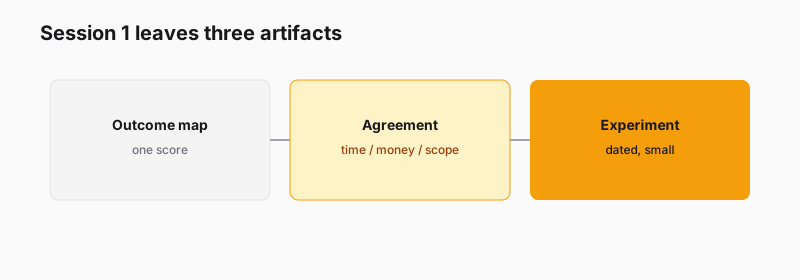
The fix: treat session 1 as a build. Three artifacts leave the room: an outcome map, a working agreement, a first experiment.
Artifact 1 — Outcome Map (20 minutes)
One primary outcome. A 1–10 on it today. A picture of “8” in behavioral terms, not adjectives.
“If we are at an 8 in 90 days, what will you be doing on a normal Wednesday that you are not doing now?”
Write it where they can see it. If they give you five outcomes, rank them. The top one is the engagement. The rest are parking lot.
Constraints go on the same page: hours they actually have, money rules, people who can veto the work. Constraints are not drama. They are the walls of the map.
Artifact 2 — Working Agreement (15 minutes)
Say the ugly parts while they still like you.
- How we use time (you will interrupt stories that are not on the contract).
- How we cancel (the 24-hour line, not a vibe).
- How we message (portal or email, not midnight text).
- What coaching is not (therapy, legal strategy, what they should buy).
- How we will know it is working (the three-point note, reviewed every 4–6 sessions).
If they flinch at any of this, good. Better now than session 6.
Artifact 3 — First Experiment (15 minutes)
Not a journal prompt. A thing they will do once before session 2.
“What’s the smallest version of the Wednesday-at-8 behavior you can run in the next seven days?”
Date it. Write how you will know. If they cannot picture the calendar, shrink it until they can.
The 60-Minute Run of Show
- 0–5 — Welcome, cameras, “this hour we will leave with three artifacts.”
- 5–25 — Outcome map.
- 25–40 — Working agreement.
- 40–55 — First experiment.
- 55–60 — Recap the three artifacts. Book session 2. Send the map the same day.
If intake already captured goals, do not re-interview. Confirm, tighten, score. Re-interviewing is how biography sneaks back in.
What Most Coaches Get Wrong
They save the working agreement for “when it comes up.” It comes up as a mess. They also overbuild the map — three pages, color, a framework they learned in a certification. One page. One score. One experiment.
They hide the three artifacts in a private note. Then the client cannot remember the hour. Send the map. If your portal can show it, use the portal. If not, a one-page doc is enough.
A Sample Map (one page)
Outcome: “Two paid conversations on the calendar each week.” Score today: 3/10. Wednesday-at-8: Outreach block 9–10am, three named people, send before 10. Constraints: Kids’ pickup at 3; no work after 7; partner sees invoices. Agreement: 24-hour cancel, portal not text, coaching ≠ their accountant. Experiment: Send the three notes by Friday noon. Screenshot the sent folder.
If your map is longer than this, you are hiding. Cut until it fits on one screen.
After They Leave
Same day, send the three artifacts back. Subject line: “Session 1 — map, agreement, experiment.” If you wait until Thursday, session 1 becomes a feeling. Feelings do not survive Labor Day.
Book session 2 before they stand up. An unbooked first session is how new clients become “I need to check my September.”
What You Do Not Do in Session 1
- A values card sort that produces no Tuesday behavior
- A full life timeline
- Three packages they already bought
- A tour of your portal’s every tab
- “So tell me about your childhood”
If a topic is not required for the map, the agreement, or the experiment, it waits. Waiting is not cold. It is how session 2 has a job.
When DIY Isn’t Enough
When session 1 still requires you to hunt forms, agreements, and a payment link, the hour is leaking into admin. Launch, Grow, and Scale exist to put intake, agreement, and the first recap on rails so you can stay on the map.
Want session one to produce a map instead of a transcript? Let’s talk.